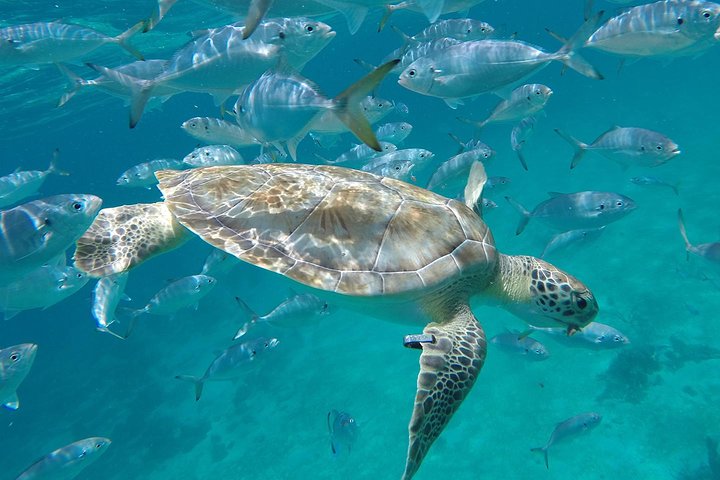
February represents a popular period for the marine environment at Folkestone Marine Park. While the terrestrial climate remains consistently dry, the underwater ecosystem conditions are influenced by the winter sea states along the \”Platinum Coast.\” For those conducting marine species identification, this month offers excellent opportunities on calm days when horizontal visibility can exceed 25 to 30 metres. However, visitors should be aware of occasional North Atlantic swells, which can impact the usually calm West Coast waters and affect clarity around the 500-metre offshore reef system.
The environmental conditions are characterized by water temperatures that hover at a consistent 26°C (79°F). This pleasant thermal stability allows for extended observation times. Snorkelers frequently observe schools of Blue Tangs moving in dense \”grazing fronts\” across the reef tops, feeding on algae that thrives in the sunlight. Understanding these behaviors is essential for visitors who wish to look beyond the surface and engage with the scientific reality of the reserve’s Snorkeling & Park Activities.
During this period, the \”Recreational Zone\” is vibrant with marine life, including the proliferation of Sea Plumes (Pseudopterogorgia). These soft corals often display high polyp extension in the currents, filtering nutrients from the water column. This activity supports the health of the reef structure and provides a habitat for smaller reef fish. Before heading into the water, visitors should consult the Plan Your Visit guide to understand the current sea states, flag warnings regarding swells, and buoy markers that define the protected zones.
The Deep Blue: A Corridor of Sound
February marks the peak window for Humpback whale migrations through the deep offshore waters located just beyond the island’s coast. While the whales themselves rarely venture into the shallow 5-metre depths of the Folkestone inshore reef, their presence is undeniable to those in the water column. The West Coast shelf possesses unique acoustic properties that amplify low-frequency sounds, turning the marine park into a natural amphitheatre.
Listening for the Undersea Concert
Snorkelers often report an “underwater singing” phenomenon. This consists of melodic moans, rhythmic clicks, and long-form “songs” performed by males. These sounds can travel hundreds of kilometres through the deep trench but become audible to the human ear when they bounce off the coral limestone shelves. It is a rare moment where the deep ocean and the coastal reserve intersect, providing a sensory link to the pelagic giants of the Atlantic.
The Stoplight Parrotfish (Sparisoma viride) is a keystone species for the health of the Folkestone reef, responsible for the bioerosion that creates the island’s white sand. In the clear February light, identifying the “Terminal Phase” (adult male) becomes significantly easier for the amateur naturalist. These males are identifiable by a distinct yellow spot located at the top of the gill cover and a secondary yellow spot at the base of the tail. Their bodies are a deep teal-blue, which contrasts sharply against the limestone reef.
Observing the Parrotfish is more than a visual exercise; it is an auditory one. If you remain still in the water, you can hear the audible “crunch” of their beak-like teeth scraping algae off the coral substrate, a process that maintains the ecological balance of the reef.
Folkestone Ranger Observation
Contrastingly, the “Initial Phase” females and juveniles display a completely different colour palette, featuring a red underbelly and mottled reddish-brown scales. February is a peak time to observe these distinct phases due to excellent water clarity. As visibility remains high, you can observe these fish moving between the shallow reef and the deeper waters near the Stavronikita shipwreck. For more on the history of this wreck and its role as an artificial reef, visit our Museum & Marine Heritage page.
Neon Blue Inhabitants: Juvenile Yellowtail Damselfish
The “Recreational Zone” at Folkestone—the park’s designated area for snorkeling—is an excellent place to spot the juvenile Yellowtail Damselfish. These juveniles are a striking departure from their adult counterparts. While the adults are dark-bodied with subtle yellow tails, the juveniles possess a deep midnight-blue body, covered in brilliant, iridescent neon blue spots that appear to glow in the sunlight. These “jewel” spots eventually disappear as the fish matures, making the clear waters of early spring a prime time to spot this transient life stage.
Their survival strategy is intrinsically linked to the Fire Coral (Millepora) colonies. These juveniles use the stinging branches of the coral as a defensive perimeter. Predators are deterred by the coral’s nematocysts, while the Damselfish, through a combination of agility and skin mucus, navigate the branches unharmed. This symbiotic relationship is a primary focus of the conservation efforts detailed in our Barbados Snorkeling Safety guide, which emphasizes the importance of not touching these stinging structures.
The iridescent blue spots of the juvenile Damselfish are not just for show; they act as a high-contrast signal in the shallow waters, often warning predators of the stinging coral they call home.
Late-Season Hawksbill Turtle Emergence
While the peak nesting season for the Hawksbill Turtle (Eretmochelys imbricata) typically runs from May to October, hatching events can extend well into the new year. February often sees "straggler" nests hatching, particularly from eggs laid late in the season. This phenomenon is concentrated along the darker stretches of the coastline, specifically near the St. James Parish Church boundary. This area is preferred by nesting females because it offers a reprieve from the significant light pollution found further south in Holetown. These late-season hatchlings face a precarious journey to the water, as they rely on the moonlight reflecting off the ocean to navigate.
Visitors walking the beach at night should be aware of these emergence events. The hatchlings are particularly vulnerable to artificial light, which can disorient them and lead them toward the road rather than the sea. If you are staying in the area, using the transport services to reach the park during daylight hours is the best way to observe the turtle feeding grounds near the inshore reef without disturbing the nocturnal nesting sites. This late-season emergence is a reminder of the fragile balance required to maintain Barbados’ turtle populations.
Further Observations: Sea Stars and Flying Fish
Beyond the reef, the sandy flats are home to the Cushion Sea Star (Oreaster reticulatus). While these large, heavy stars often migrate to deeper offshore waters during winter to avoid turbulence, they can still be spotted on calmer days foraging in 3–5 metres of water for seagrass detritus. Simultaneously, just beyond the reef break, the Barbados Flying Fish (Hirundichthys affinis) are at the height of their season. Between 6:00 AM and 8:00 AM, these fish can be seen “gliding” over the surface for distances of up to 50 metres, a spectacular display of maritime evasion.
Adventure Seekers
Barbados Turtle and Shipwreck Snorkel Adventure
★★★★★4.8 (915+ reviews)|Flexible
Join us aboard Tranquility Cruises a Snorkel Boat for our 90 minutes turtle & shipwreck adventure. The cruise departs from our. Dock in the Careenage in Brid…
Nature Lovers
Folkestone Coral Reef Clear Kayak Tour
★★★★★4.2 (20+ reviews)|Flexible
Take in some of the most picturesque shoreline on the west coast of Barbados as we set off from Surfside beach and head to Folkstone Marine Park. Here you wi…
Best Value
Barbados Shore Excursion Snorkel cruise and Beach Day
★★★★★4.4 (442+ reviews)|Flexible
Hop on our shuttle to Savvy on the Bay and board our vessel Tranquility with ease and join us on our 1.5 hour Turtle & Shipwreck adventure in Carlisle Bay.
…
Couple’s Choice
Discover Rum Barbados Tour
★★★★★4.8 (178+ reviews)|Flexible
Explore some of the rums of Barbados, discover how the rum is made and best of all, taste the flavors of award winning rum.
Bestseller
Original Bajan Walking Food Tour
★★★★★4.8 (1377+ reviews)|Flexible
Eat like a local with Barbados’ first walking food tour as we take you on an exciting journey through the streets and by-ways of this island’s largest and mo…
Family Friendly
Hotel Beach Day at Savvy with Shuttle Transfer
★★★★★4.3 (9+ reviews)|Flexible
There is no better place in the world to spend a day at the beach than Barbados.Carlisle Bay has silky white sand with stunning turquoise blue sea. It is …
Marine Species FAQ: February Edition
Can I see Humpback whales from the shore at Folkestone? While sightings of the whales breaching are rare from the shoreline, the acoustic experience is a magical possibility for lucky snorkelers. Because the deep-water shelf drop-off is situated just a few kilometres offshore, it is sometimes possible to “see” them by listening for their low-frequency songs while submerged in the water column during peak February conditions.
Is it legal to collect Sea Eggs (Sea Urchins) during February? No, February is outside the regulated harvest season for Sea Eggs in Barbados. The white-spined sea urchins you see in the rocky crevices are currently in a protected growth phase, and disturbing them is strictly prohibited by the Fisheries Act to ensure the population recovers for future seasons.
Why are the Yellowtail Damselfish so blue right now? The brilliant neon blue colour is specific to the juvenile phase of the species, and February is a prime month to spot these juveniles congregating in the park’s coral crevices. As they grow into adults, they will lose this iridescence and develop a darker, more uniform body colour with a yellow tail, which is better for camouflage in deeper reef sections.
What is the best time of day to see Flying Fish? Flying Fish are most active in the early morning hours, typically between 6:00 AM and 8:00 AM. However, they are open-ocean fish; while rare to see snorkeling near shore, they are frequently spotted “gliding” over deeper waters by visitors taking boat transfers or catamaran cruises just beyond the Folkestone reserve.
Are the Cushion Sea Stars dangerous to touch? While Cushion Sea Stars are not venomous, it is vital to the health of the organism that they are not removed from the water. Taking them out of the ocean causes significant physiological stress and can lead to the death of the animal; it is best to observe them at their natural depth of 3-5 metres.
What is being done to protect the Elkhorn Coral at Folkestone? The Scientific Zone at Folkestone serves as a primary monitoring site for Elkhorn Coral (Acropora palmata) recovery. Scientists are rehabilitating these thick-branching corals to serve as a natural wave break for the Holetown shoreline, and the clear February visibility allows for detailed monitoring of their growth rates.